Pure Bilona Ghee Delivered FREE across india with discounted price for new customers

Ghee vs Refined Oil: Which Is Better for Everyday Cooking?
Confused between ghee and refined oil? Compare smoke point, nutrition, processing methods, and cooking benefits to discover which option is better for your family's daily meals.
RAJASTHAN ORGANICS BLOG
- Ekta Amit Bishnoi
6/23/20263 min read
Is Ghee Better Than Refined Oil?
Walk into any kitchen today and you'll likely find refined cooking oils sitting next to traditional ghee. While refined oils have become common in modern households, many people are now questioning whether they are actually better than traditional fats like A2 Bilona Ghee.
For generations, Indian families cooked with ghee long before refined oils became popular. Today, growing awareness about food quality and traditional nutrition has brought this debate back into the spotlight.
Let's compare ghee and refined oil across key factors that matter for everyday cooking.
1. Smoke Point Comparison: Which Fat Handles Heat Better?
One of the most important factors when choosing a cooking fat is its smoke point.
The smoke point is the temperature at which a fat begins to break down and produce smoke. When oils are heated beyond this point, their flavor and quality may be affected.
Ghee
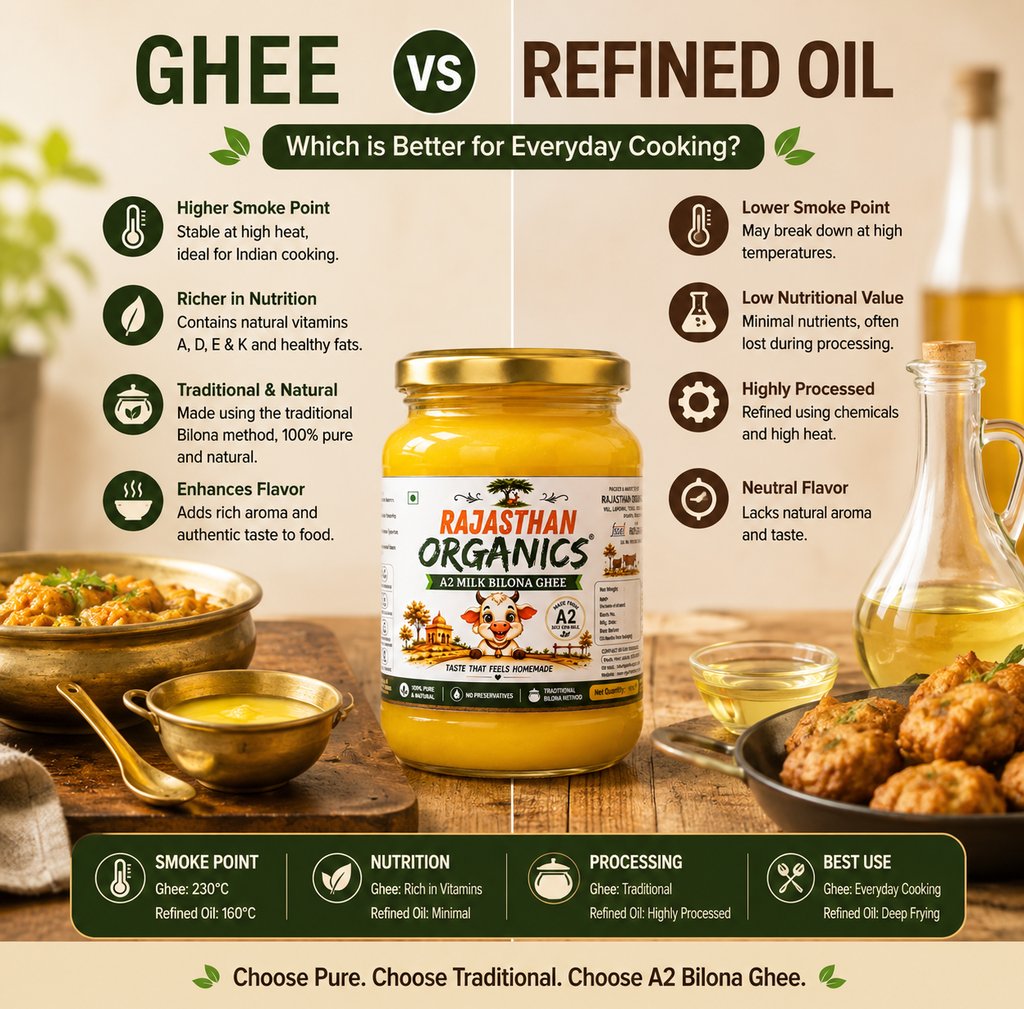
Pure ghee has a naturally high smoke point, typically around 230°C to 250°C.
This makes it suitable for:
✔ Tadka (tempering)
✔ Sautéing vegetables
✔ Roasting
✔ Shallow frying
✔ Everyday Indian cooking
Because milk solids are removed during the preparation process, ghee remains stable at high cooking temperatures.
Refined Oils
Many refined oils also have relatively high smoke points due to industrial processing.
However, the refinement process often involves bleaching, deodorizing, and chemical treatment to increase shelf life and alter flavor.
Winner for High-Heat Cooking
For traditional Indian cooking methods that involve heating food thoroughly, ghee performs exceptionally well because of its natural heat stability.
Internal Link Opportunity
👉 Read: The Traditional Bilona Process: From Milk to Pure Golden Ghee
2. Nutritional Differences Between Ghee and Refined Oil
When comparing foods, nutritional quality matters just as much as cooking performance.
What Ghee Offers
Pure A2 Bilona Ghee naturally contains:
Fat-soluble vitamins A, D, E, and K
Naturally occurring fatty acids
Butyric acid
Healthy fats that support nutrient absorption
Ghee also enhances the absorption of vitamins found in vegetables and other foods.
What Refined Oils Offer
Refined oils primarily provide fat and calories.
Depending on the oil source, they may contain certain beneficial fatty acids. However, extensive processing can alter some naturally occurring compounds.
The nutritional value often depends heavily on:
Source material
Refining method
Storage conditions
Winner for Traditional Nutrition
Traditional ghee provides additional naturally occurring nutrients that have made it a valued food for generations.
Internal Link Opportunity
👉 Read: Why Did Our Grandparents Eat Ghee Every Day? Traditional Wisdom & Modern Science
3. Traditional Fats vs Processed Fats
Perhaps the biggest difference lies in how these products are made.
Traditional A2 Bilona Ghee
The Bilona process follows an age-old method:
Fresh milk is converted into curd.
Curd is churned into butter.
Butter is slowly heated to produce pure ghee.
No bleaching.
No deodorizing.
No industrial refining.
The result is a natural product with its original aroma, flavor, and richness.
Refined Oils
Most refined oils undergo multiple industrial processes including:
Extraction
Heating
Refining
Bleaching
Deodorizing
These steps improve shelf stability and appearance but create a product very different from its natural source.
Winner for Natural Processing
Traditional ghee remains one of the least processed cooking fats commonly available today.
Internal Link Opportunity
👉 Read: A2 Bilona Ghee vs Regular Ghee: What Makes It Different?
4. Best Cooking Uses: Where Does Each One Work Best?
Every cooking fat has strengths depending on the recipe.
Best Uses for Ghee
Ghee works beautifully in:
✔ Dal and khichdi
✔ Rotis and parathas
✔ Tadka
✔ Traditional sweets
✔ Rice dishes
✔ Roasting vegetables
✔ Ayurvedic recipes
✔ Morning ghee coffee
Its rich aroma enhances both flavor and satisfaction.
Best Uses for Refined Oils
Refined oils are often used for:
✔ Deep frying
✔ Neutral-flavor cooking
✔ Commercial food preparation
However, they generally do not contribute the same depth of flavor as ghee.
Which Is Better?
If your goal is traditional Indian cooking, authentic taste, and natural nutrition, ghee often offers advantages that refined oils cannot replicate.
Many households choose to use both, but increasingly prefer ghee for daily cooking whenever possible.
Why More Families Are Returning to Ghee
Across India, many families are rediscovering traditional foods and cooking methods.
Reasons include:
Desire for less processed foods
Interest in traditional nutrition
Better flavor in home-cooked meals
Greater awareness of ingredient quality
As people become more conscious of what goes into their food, traditional fats like A2 Bilona Ghee are regaining popularity.
How to Choose the Right Ghee
When buying ghee, look for:
✔ A2 Cow Milk Source
✔ Traditional Bilona Method
✔ No Artificial Additives
✔ Authentic Aroma
✔ Trusted and Transparent Brand
Quality matters far more than marketing claims.
Final Verdict: Is Ghee Better Than Refined Oil?
There is no single answer that fits every person or every kitchen.
However, when comparing:
✔ Heat Stability
✔ Traditional Preparation
✔ Natural Nutrition
✔ Flavor Enhancement
✔ Minimal Processing
Pure A2 Bilona Ghee offers several advantages that make it an excellent choice for everyday Indian cooking.
The real question may not be whether ghee is better than refined oil—but whether returning to traditional, minimally processed foods can help us make better choices for our families.
For generations, Indian kitchens trusted ghee. Today, many households are rediscovering why.
Rajasthan Organics
Registered Address : WARD NO. 04, NEAR STATE BANK OF INDIA, LIKHMISAR, PILIBANGA, HANUMANGARH - 335803
Contact us :
Newsletter
EMail :
info@rajasthanorganics.com
Call Us : +91 8619328204
© 2024. All rights reserved.