🔥 First 50 Customers Only! Get ₹250 OFF on orders above ₹1999 with code WELCOME50. Hurry, once the first 50 orders are claimed, the offer is gone! ⏳💛

Why Small-Batch Ghee Production Matters: Quality, Purity & Traditional Craftsmanship
Discover why small-batch ghee production matters. Learn how it supports quality, freshness, traditional Bilona methods, better taste, transparency, and consumer trust.
RAJASTHAN ORGANICS BLOG
- Ekta Amit Bishnoi
7/3/20263 min read
Why Small-Batch Ghee Production Matters: The Secret Behind Quality, Purity, and Authentic Taste
In today's world of large-scale food production, most products are manufactured in massive quantities to meet growing demand. While this approach increases availability, it often comes at the cost of quality, attention to detail, and traditional craftsmanship.
When it comes to A2 Bilona Ghee, the method of production plays a significant role in determining its purity, aroma, texture, and overall quality. This is where small-batch ghee production stands apart.
But what exactly does "small-batch" mean, and why should it matter to you as a consumer?
Let's explore in detail.
What Is Small-Batch Ghee Production?
Small-batch production refers to preparing ghee in limited quantities at a time rather than producing thousands of kilograms in a single industrial process.
Instead of prioritizing volume, small-batch production focuses on:
✔ Quality
✔ Consistency
✔ Traditional methods
✔ Careful supervision
✔ Attention to detail
Every stage of the process receives closer monitoring, resulting in a product that reflects authenticity and craftsmanship.
The Difference Between Industrial and Small-Batch Production -
Industrial Production
Large-scale production often focuses on:
High output
Faster processing
Automated systems
Cost efficiency
While these systems are effective for mass production, they may not always preserve the traditional characteristics that many consumers seek.
Small-Batch Production
Small-batch production emphasizes:
Controlled preparation
Traditional techniques
Detailed quality checks
Careful handling
The goal is not simply to produce more ghee but to produce better ghee.
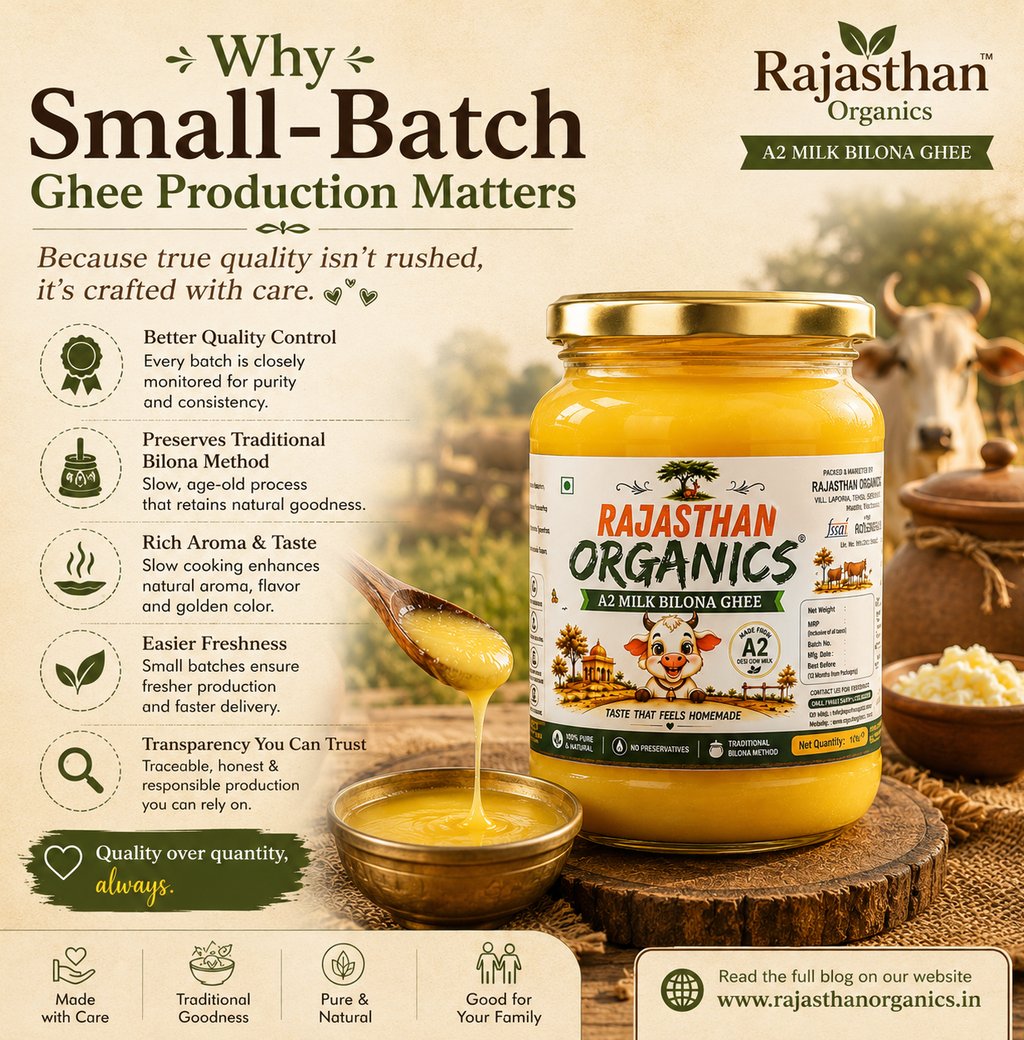
1. Better Control Over Quality
One of the biggest advantages of small-batch production is quality control.
Why It Matters
When smaller quantities are produced:
Each batch can be closely monitored.
Consistency can be maintained.
Any issue can be identified quickly.
Higher standards can be followed throughout production.
Result
Consumers receive a product that is more reliable and consistent from batch to batch.
Quality becomes a priority rather than an afterthought.
2. Preserves Traditional Bilona Practices
Authentic Bilona Ghee is not a quick process.
Traditional preparation involves:
Step 1
Fresh milk collection.
Step 2
Natural curd formation.
Step 3
Churning curd to obtain butter.
Step 4
Slow heating of butter to create ghee.
This process requires patience and careful handling.
Why Small Batches Help
Traditional techniques are easier to manage in smaller quantities.
Producers can:
Monitor each stage carefully.
Maintain consistency.
Follow age-old practices more accurately.
The result is ghee that remains closer to traditional standards.
3. Superior Aroma and Flavor
Anyone who has experienced authentic Bilona Ghee knows that aroma matters.
Why Aroma Develops Better
During slow preparation:
Natural milk solids caramelize gradually.
Rich flavors develop naturally.
Traditional aroma is preserved.
Small-Batch Advantage
Smaller production runs allow:
Better temperature control.
More careful heating.
Greater attention during the final cooking stage.
This helps create the rich aroma and taste that many consumers associate with homemade ghee.
4. Greater Attention to Every Batch
Mass production relies heavily on automation.
Small-batch production often involves greater human involvement.
What This Means
Every batch receives:
Individual attention
Careful observation
Manual quality checks
Producers can evaluate:
Texture
Color
Aroma
Consistency
This level of attention is difficult to achieve in extremely large-scale operations.
5. Freshness Is Easier to Maintain
Freshness plays an important role in the overall experience of using ghee.
Benefits of Small-Batch Production
Smaller quantities mean:
Faster inventory turnover
Reduced long-term storage
More frequent production cycles
This helps ensure customers receive fresher products.
Why Consumers Appreciate This
Freshly prepared ghee often offers:
Better aroma
Richer taste
More satisfying culinary experience
6. Easier Traceability and Transparency
Today's consumers want to know where their food comes from.
Small-Batch Producers Can Often Provide:
Batch information
Production details
Sourcing transparency
Greater accountability
Why This Builds Trust
Consumers feel more confident when they know:
How the product was made
Where ingredients came from
Who is responsible for quality
Transparency strengthens long-term customer relationships.
7. Supports Artisan Food Production
Small-batch production is often closely connected with traditional food craftsmanship.
Benefits
It helps preserve:
Traditional knowledge
Cultural heritage
Authentic preparation methods
Many traditional food practices survive because dedicated producers continue making products in smaller quantities.
8. Consistency Through Care, Not Speed
Large-scale production often focuses on efficiency.
Small-batch production focuses on precision.
The Difference
Instead of rushing production:
Time is given to each step.
Processes are carefully managed.
Standards are maintained consistently.
Consumers receive a product crafted with patience rather than speed.
9. Better Customer Trust
Trust is one of the most important factors in food purchases.
Consumers increasingly value:
Transparency
Authenticity
Traditional preparation
Quality-focused production
Small-batch production naturally supports these values.
When customers understand how their ghee is made, they often feel a stronger connection with the brand.
10. Reflects a Commitment to Quality Over Quantity
Perhaps the most important benefit of small-batch production is what it represents.
It Says:
"We choose quality before volume."
Rather than maximizing output, small-batch producers focus on:
Craftsmanship
Purity
Consistency
Customer satisfaction
This philosophy often becomes visible in the final product.
Why Rajasthan Organics Believes in Small-Batch Production
At Rajasthan Organics, we believe that exceptional ghee begins with exceptional care.
Our A2 Bilona Ghee is crafted in small batches to ensure:
💛 Consistent quality
💛 Traditional Bilona preparation
💛 Rich aroma and authentic taste
💛 Careful monitoring at every stage
💛 A product you can trust for your family
By focusing on quality rather than quantity, we aim to bring the goodness of traditional ghee-making to modern households.
Conclusion
Small-batch ghee production is about much more than producing smaller quantities. It represents a commitment to quality, tradition, transparency, and craftsmanship.
From better quality control and freshness to preserving authentic Bilona methods and building customer trust, small-batch production helps ensure that every spoonful reflects the care that went into making it.
When choosing A2 Bilona Ghee, understanding how it is produced can be just as important as understanding where it comes from.
Because true quality isn't rushed—it is crafted with patience, tradition, and care.
Rajasthan Organics
Registered Address : WARD NO. 04, NEAR STATE BANK OF INDIA, LIKHMISAR, PILIBANGA, HANUMANGARH - 335803
Contact us :
Newsletter
EMail :
info@rajasthanorganics.com
Call Us : +91 8619328204
© 2024. All rights reserved.